FabricGen: Microstructure-Aware Woven Fabric Generation
Abstract
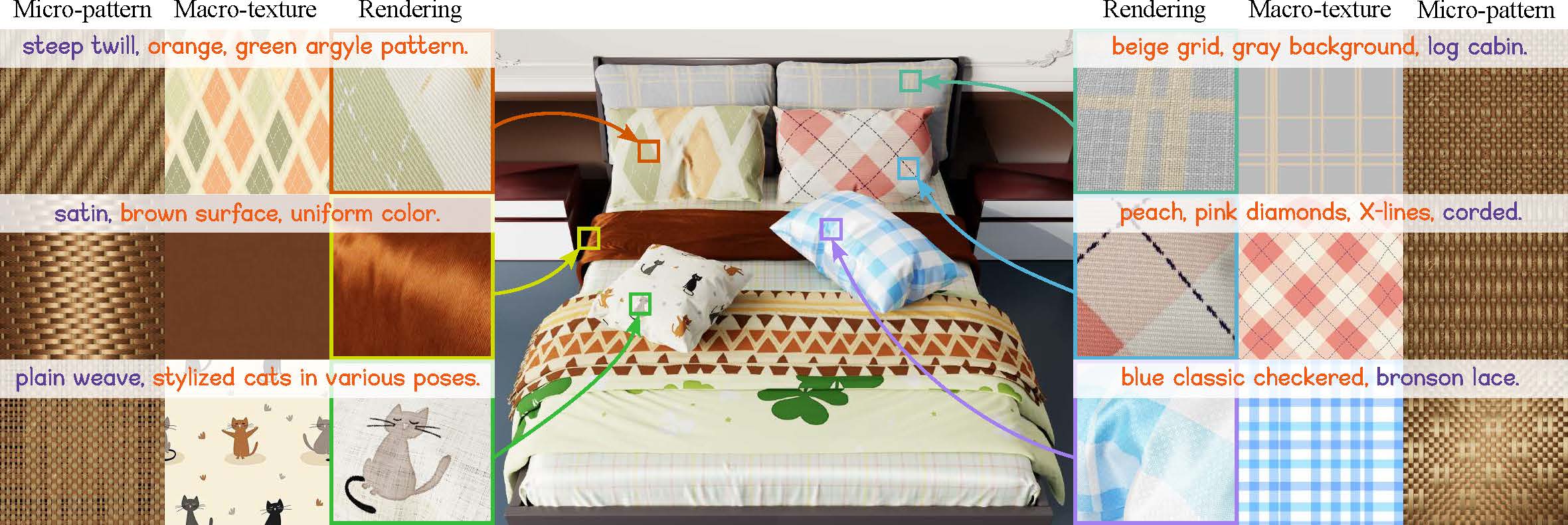
Woven fabric materials are widely used in rendering applications, yet designing realistic examples typically involves multiple stages, requiring expertise in weaving principles and texture authoring. Recent advances have explored diffusion models to streamline this process. However, pre-trained diffusion models often struggle to generate intricate yarn-level details that conform to weaving rules. To address this, we present \emph{FabricGen}, an end-to-end framework for generating high-quality woven fabric materials from textual descriptions. A key insight of our method is the decomposition of macro-scale textures and micro-scale weaving patterns. To generate macro-scale textures free from microstructures, we fine-tune pre-trained diffusion models on a collected dataset of microstructure-free fabrics. As for micro-scale weaving patterns, we develop an enhanced procedural geometric model capable of synthesizing natural yarn-level geometry with yarn sliding and flyaway fibers. The procedural model is driven by a specialized large language model, WeavingLLM, which is fine-tuned on an annotated dataset of formatted weaving drafts, and prompt-tuned with domain-specific fabric expertise. Through fine-tuning and prompt tuning, WeavingLLM learns to design weaving drafts and fabric parameters from textual prompts, enabling the procedural model to produce diverse weaving patterns that stick to weaving principles. The generated macro-scale texture, along with the micro-scale geometry, can be used for fabric rendering. Consequently, our framework produces materials with significantly richer detail and realism compared to prior generative models.
Pipeline
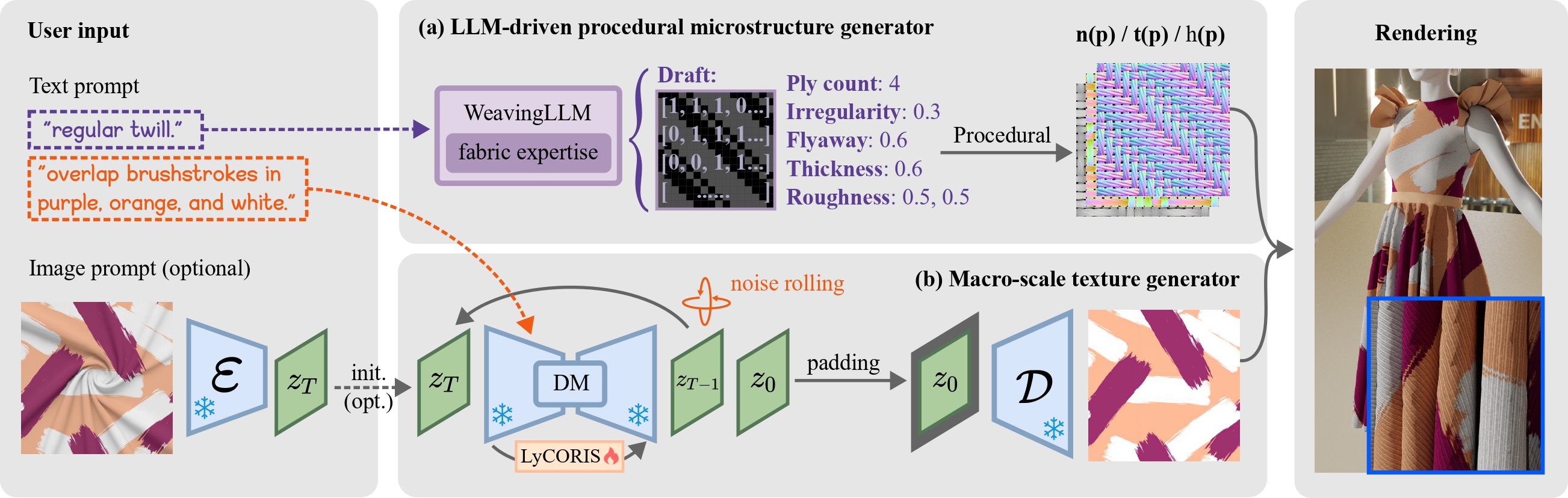
Overview of FabricGen. Our fabric material creation framework consists of two main components: (a) an LLM-driven procedural microstructure generator that generates yarn-level microstructures along with fabric parameters, and (b) a texture generator that generates tileable, macro-scale textures from a text prompt (and optional image).
Results
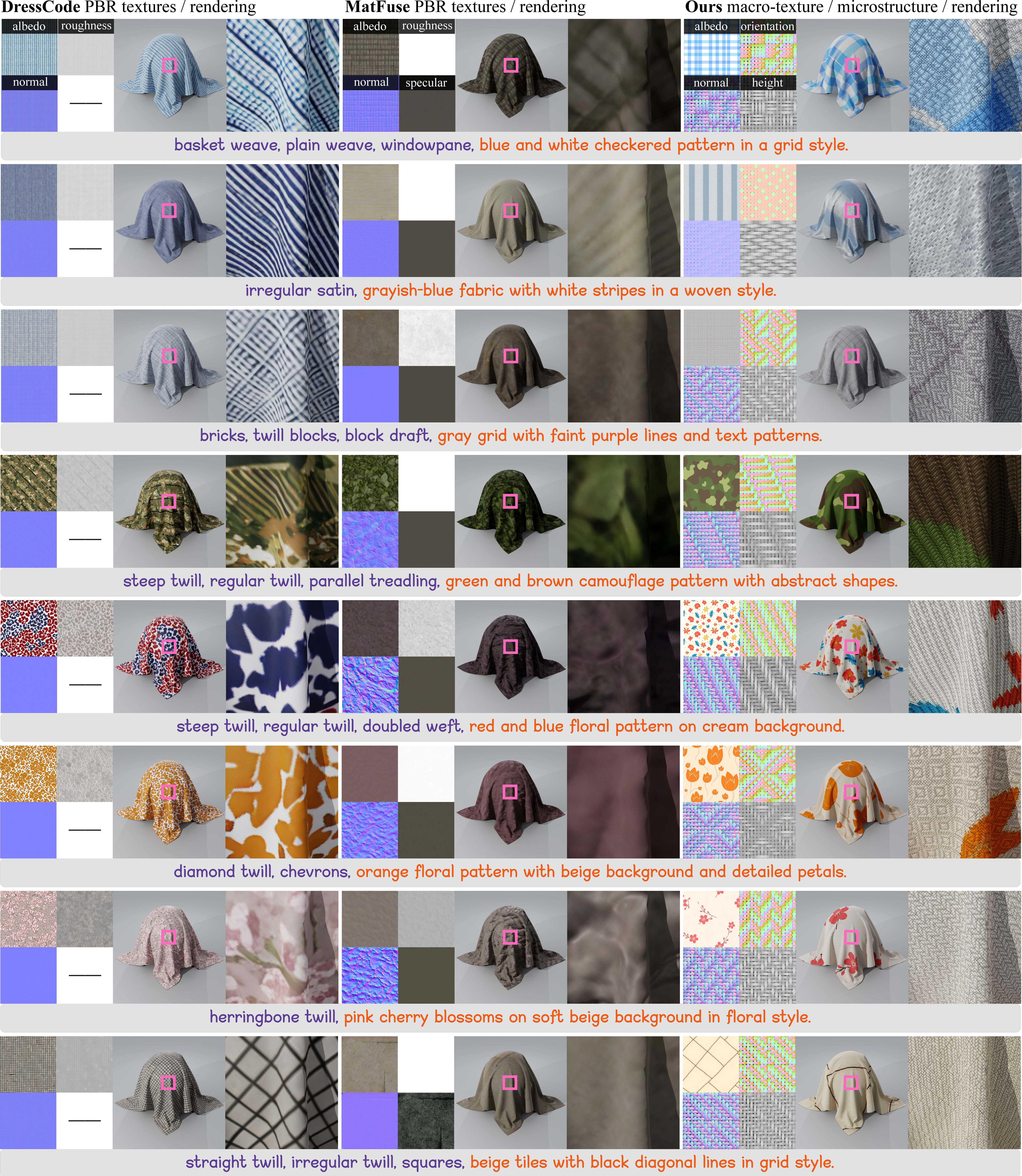
Comparison on text conditioning. Given text prompt, DressCode and MatFuse generate PBR textures, which struggle to capture fine fabric details, resulting in blurring and distortion in close-up views. In contrast, our method generates procedural microstructure together with macroscale texture, ensuring a realistic appearance in both macro and close-up views.
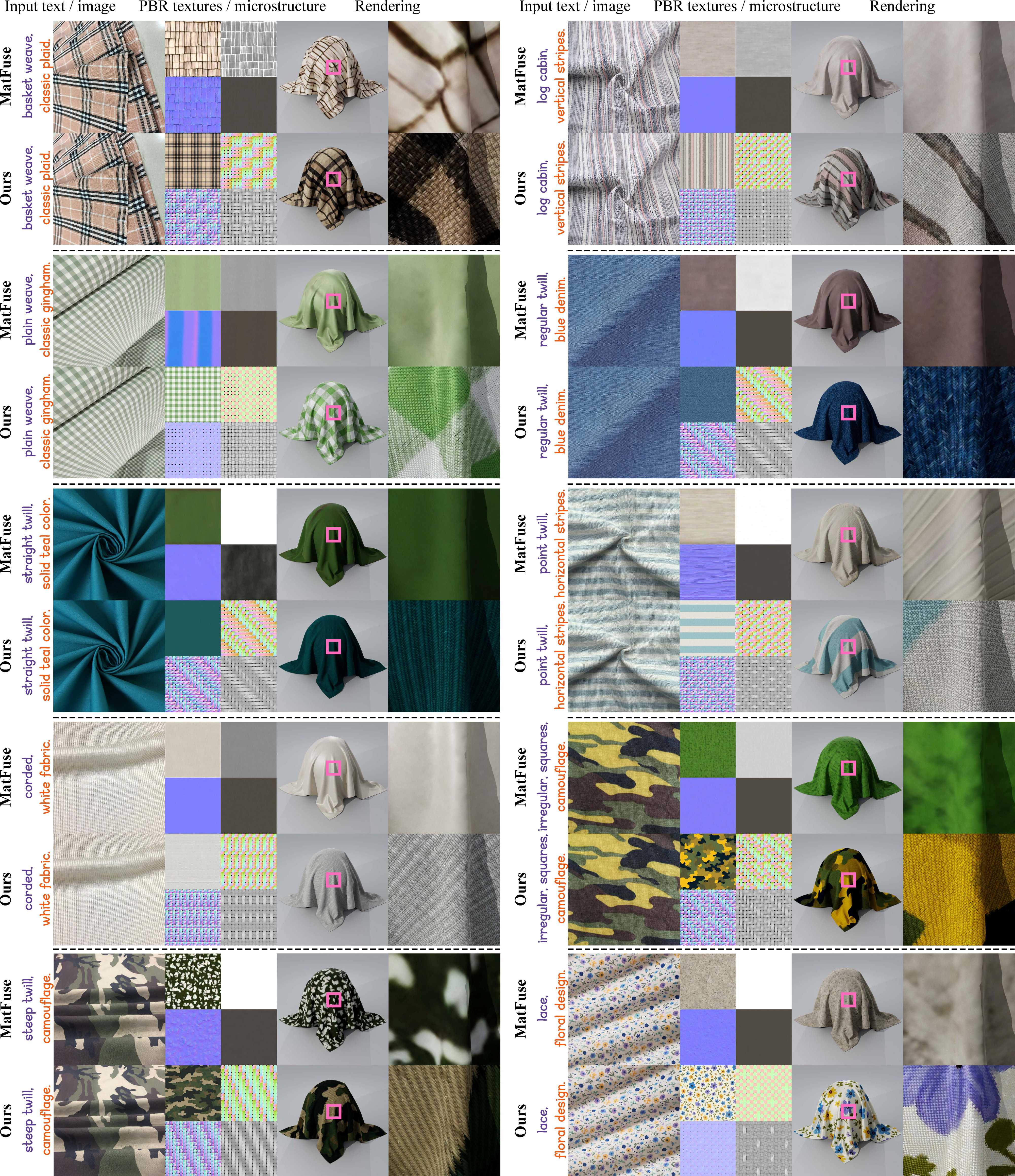
Comparison on text and image conditioning. Given both text and image prompts, our generated materials achieving better consistency and richer detail than MatFuse.
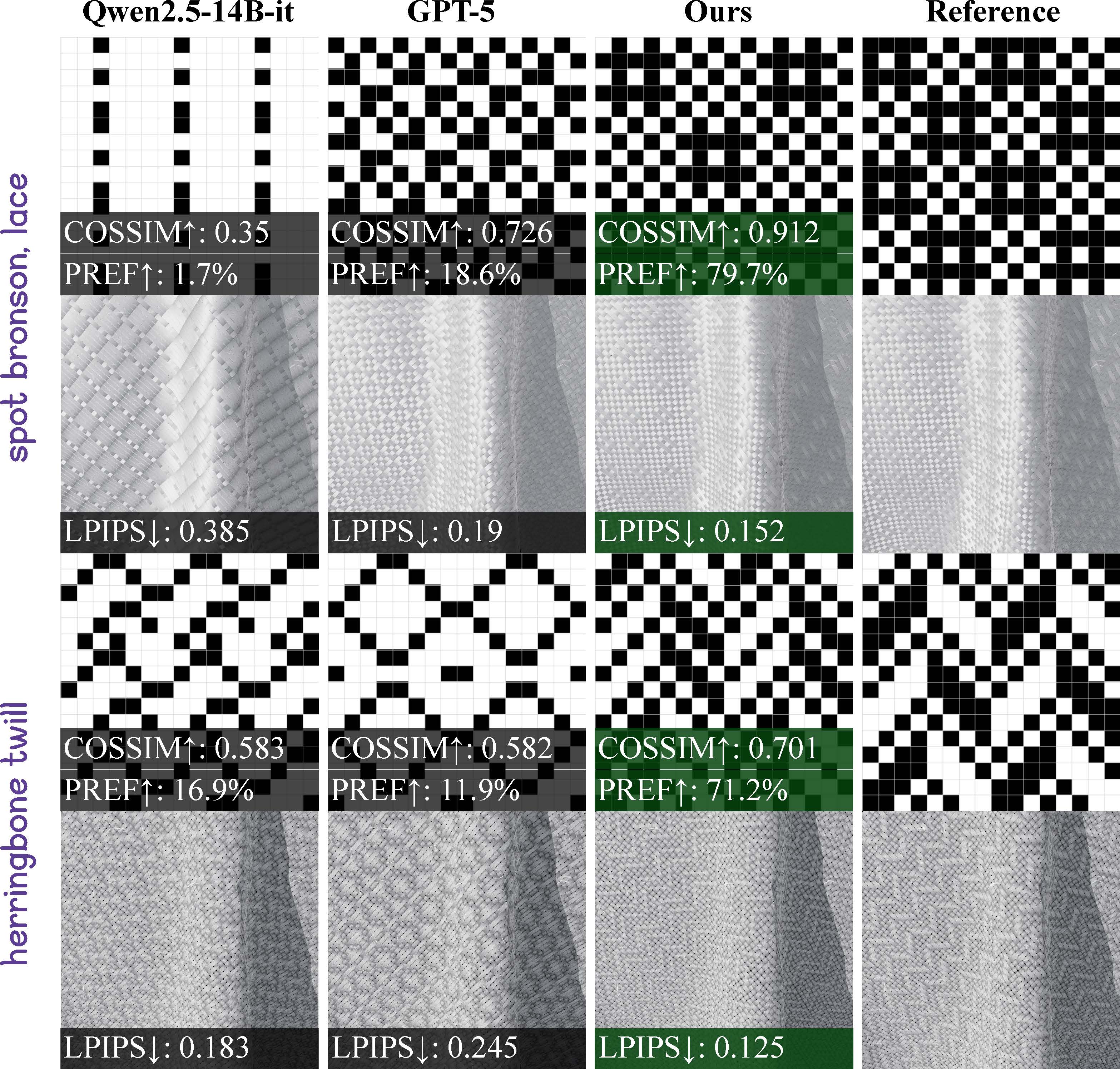
Comparison among WeavingLLM, Qwen2.5, and GPT-5. COSSIM indicates the cosine similarity of Fourier spectra, and PERF indicates the user preferences ratio. All renderings use a pure gray albedo map. More reference drafts are provided in the supplementary material.
BibTeX
@inproceedings{Tang2026FabricGen,
  title={FabricGen: Microstructure-Aware Woven Fabric Generation},
  author={Yingjie Tang and Di Luo and Zixiong Wang and Xiaoli Ling and Jian Yang and Beibei Wang},
  booktitle={CVPR},
  year={2026}
}